
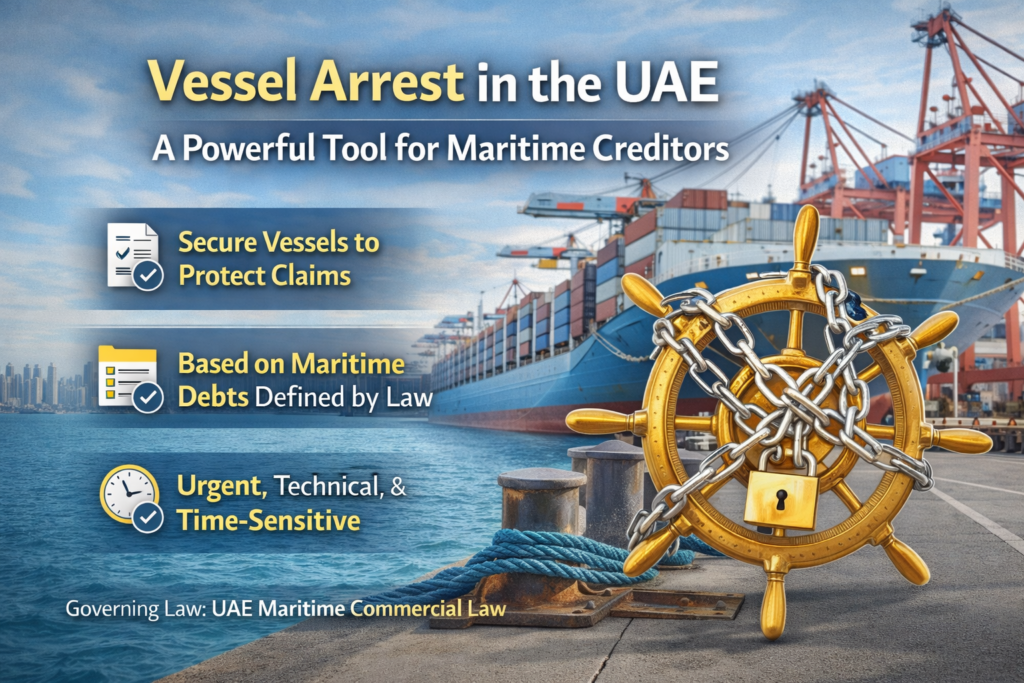
In the maritime industry, time is money — and security is everything.
When a shipowner fails to pay outstanding dues, bunker suppliers remain unpaid, or charter hire is in default, creditors are often left with one urgent question:
How can we secure our claim before the vessel sails away?
Under UAE law, the answer may lie in one of the most effective remedies available in maritime practice — vessel arrest.
What is Vessel Arrest?
Vessel arrest is a precautionary legal measure that allows a claimant to detain a ship through court order as security for a maritime debt.
Unlike ordinary commercial disputes, maritime law recognizes that ships are mobile assets. If immediate action is not taken, a vessel may leave UAE territorial waters — making recovery far more difficult.
Legal Framework in the UAE
Vessel arrest in the UAE is governed primarily by:
- UAE Maritime Commercial Law
The law outlines specific categories of claims that qualify as “maritime debts,” including:
- Damage caused by the vessel
- Loss of life or personal injury
- Salvage operations
- Charter party disputes
- Cargo damage or loss
- Unpaid bunker supplies
- Crew wages
- Port and docking fees
- Shipbuilding or repair disputes
Only claims falling within recognized maritime debt categories permit arrest.
When Can a Vessel Be Arrested?
A vessel may be arrested if:
- A maritime debt exists.
- The vessel belongs to the debtor at the time of arrest.
- The application is filed before the competent UAE court.
In certain circumstances, “sister ship arrest” may also be permitted — meaning a vessel owned by the same debtor can be arrested even if it is not the ship directly involved in the dispute.
The Arrest Procedure
The procedure is typically urgent and ex parte (without prior notice to the shipowner):
- Filing an application before the competent court.
- Submitting supporting documents proving the maritime debt.
- Obtaining a court order for arrest.
- Serving the order on port authorities.
Once arrested, the vessel cannot leave port until:
- The debt is settled, or
- Adequate security (such as a bank guarantee) is provided, or
- The arrest is lifted by court order.
Strict deadlines apply for filing the substantive claim after arrest. Failure to comply may result in release of the vessel.
Strategic Considerations for Creditors
Vessel arrest is a powerful leverage tool, but it must be handled carefully.
Key considerations include:
- Strength of documentary evidence
- Jurisdictional competence
- Risk of wrongful arrest claims
- Potential counter-security requirements
- Commercial negotiation strategy
Improper or abusive arrest can expose claimants to damages.
Risks for Shipowners
For shipowners, vessel arrest can cause:
- Operational disruption
- Port congestion charges
- Charter breach exposure
- Reputational damage
- Financial loss due to delay
Immediate legal response and negotiation strategy are essential.
Why Vessel Arrest Matters in the UAE
Given the strategic importance of ports such as Jebel Ali Port and Khalifa Port, vessel arrest is not uncommon in the UAE.
The country’s position as a global maritime hub means that creditors frequently rely on UAE courts to secure maritime claims.
A well-executed arrest can transform an unsecured claim into a secured position overnight.
Conclusion
Vessel arrest in the UAE is not merely a procedural step — it is a strategic enforcement mechanism.
For maritime creditors, it offers security and leverage.
For shipowners, it demands immediate legal attention.
In a sector where ships move quickly and liabilities can be substantial, understanding vessel arrest is essential for risk management.
Ahsan Qadeer
Legal Consultant